Mission & History

mission

Prison Book Program supports people in prison by sending them free books and reading materials that meet their specific needs and interests. We are also committed to educating our volunteers, who are vital to our operations, about the realities of the U.S. prison system.

Each package of books PBP sends holds the promise of connection. Along with the packages our volunteers prepare for mailing, they include a message of encouragement that responds to the letter the reader sent with their request. Readers often write back to thank volunteers for their messages and to let them know the importance of their encouragement. Through this correspondence, our readers feel cared about and seen—sometimes for the first time in years—and our volunteers realize what an impact they make.

Why is PBP Needed?

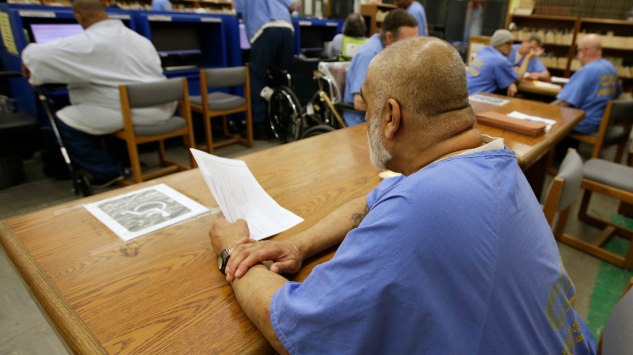
For those of us who have easy access to books, we take books for granted. But books can mean the world to people in prison. They love to learn, study, imagine and grow, just as all of us do. In the absence of educational programs and internet access, books are critical. They are often the only way for incarcerated people to learn a new language or skill, explore their faith, or enjoy a mystery or poetry. Prisons and jails, however, are generally book deserts. Prison libraries, when they exist at all, typically have poor quality collections, and few incarcerated people have loved ones with the resources to purchase and send books from expensive commercial vendors. 

This is where Prison Book Program comes in. Since 1972, we have provided books to people in over 1,000 prisons and jails across the United States. Incarcerated people write to let us know what they wish to read, and we send them carefully selected books and other print resources—always for free—which they can keep, treasure and share.

History

When Prison Book Program began in 1972, our mission was to send reading materials to incarcerated people to help them empower themselves. We operated as a loose collective of volunteers who met in the Red Book Store, a gathering place in Cambridge, Massachusetts, for leftist activists of many kinds. PBP was, at its origin, a political project that aimed to build solidarity between people on both sides of prison walls through the sharing of literature.

The PBP of today looks very different. We have a paid staff and a Board of Directors entrusted with setting the strategic direction of the organization and stewarding its resources. We are an established tax-exempt “501(c)(3)” organization that can accept tax-deductible contributions. Our core mission, however, remains largely unchanged: to provide vital support to people in prison by sending them free books and reading materials. But now we send a wide range of books– from history, language-learning and trade skills, to mysteries, crossword puzzles, and job-hunting guides. In any given year, thousands of books of every genre and format stream through our space. We do not align ourselves with any ideology regarding crime, prisons, or politics.

Our reach, of course, has expanded dramatically, thanks to financial contributions and thousands of incredible volunteers. They are the lifeblood of our organization. In many ways, U.S. incarceration tries to erase humans as individuals—from requiring uniforms and identifying people as numbers, to the destruction of any caring human relationships that people might have when they enter prison. In contrast, you’ll find real individuals in prison are everywhere at PBP. They are multi-dimensional, with their stories told in letters and poems and artwork. Members of our community believe that the people who write to us from prisons and jails deserve all of the amazing things that books can do for people, and they deserve this to exactly the same degree as any non-incarcerated reader. We want our readers to dream, grow, be challenged, and envision new possibilities for themselves.

Impact

In 2025, Prison Book Program sent nearly 65,000 books to more than 18,500 people housed in over 1,000 facilities across the U.S. Our incredible, dedicated 1,566 volunteers helped make this happen. 

The books we provide are not only educational. We know from national studies and, more importantly, from our readers, that reading itself is healing and restorative. It fosters empathy, creates community through sharing, and reduces physical and psychological stress in those who are incarcerated. Education, and reading in particular, have been shown to substantially reduce recidivism and to equip people to deal with the outside world on their release. PBP helps to create safer communities both inside and outside of prisons.     

In addition to the books we send, PBP continues to publish and distribute (now, for over 40 years) the National Prisoner Resource List (NPRL), a directory of organizations that offer services to incarcerated people. A critical resource, it lists over 150 organizations that provide family support, legal help, health information, research assistance, educational services, and much more. We know from our readers that its impact has been profound, and demand for it has never been higher.  

PBP also publishes and distributes its new Insider’s Guide to Jailhouse Law (IGJL), which is specifically designed to meet the needs of people in prison across the country.  The IGJL includes: an overview of the U.S. legal system; explanations of the rights of incarcerated people and the statutes and court decisions that protect them; information on avenues for relief for people convicted as juveniles; instructions on filing writs, motions, complaints and other legal documents pro se; a capsule legal dictionary; templates for parole hearings and motions for sentence modifications; lists of organizations that offer legal assistance; and explanations of how to use and cite statutes and court decisions. There is no other resource like the IGJL in the country. We know from our readers that, like the NPRL, its impact has been incalculable, and demand for it has grown enormously since its initial publication in 2024.   

looking ahead

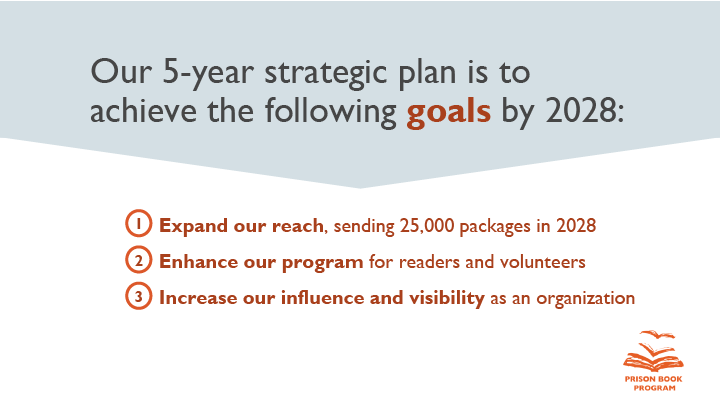
Prison Book Program’s Board and staff completed a strategic plan in May 2025 [link] that envisions PBP’s near future. The plan emphasizes that by 2028, PBP will:

  • Expand its reach and volume while continuing to respond to book requests in a timely fashion;
  • Enhance its volunteer program;
  • Improve the quality of service provided to incarcerated readers; and
  • Raise its profile as an organization in Greater Boston and nationwide through partnerships, media outreach, and events.

Jurisdictions around the country are, unfortunately, adopting increasingly restrictive book policies, allegedly to reduce contraband entering correctional facilities. This makes our work more important, but also more complicated, than ever. Our newly hired Director of Institutional Relations is now serving as the chief liaison between PBP and correctional facilities, ensuring that we have the most up-to-date information on each facility’s rules so we can function as efficiently and effectively as possible.